
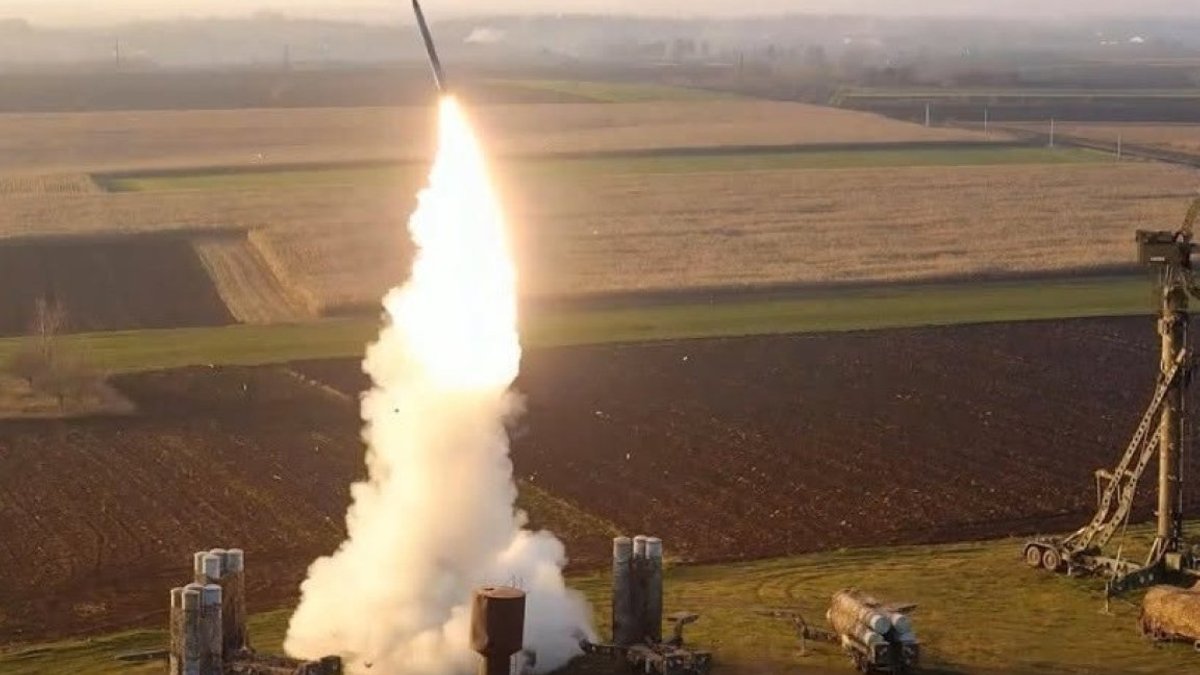
Ukraine’s first operational deployment of its domestically produced FP-7 ballistic missile marked a shift in its defense strategy, President Volodymyr Zelensky confirmed through a social media post featuring a launch video. The announcement came as Russia’s military campaign faces growing challenges, including disruptions to energy exports and repeated strikes on its refineries.
The FP-7, created by Fire Point—a Kyiv-based defense company now leading Ukraine’s arms sector—was engineered as a lightweight alternative to Russian systems like the S-400. After months of testing, the missile is expected to enter production, though the timeline remains uncertain. With a range of up to 200 kilometers and a 150-kilogram warhead, it targets fortified structures such as bunkers, according to Fire Point’s technical specifications. Development is also underway on the FP-9, a longer-range variant projected to reach 800 kilometers.
Its first combat use struck Russian-occupied territory, sources told The Wall Street Journal. The missile’s battlefield effectiveness remains unconfirmed without verified details on its target or impact.
Russia’s energy war stalls amid Ukrainian strikes
While Ukraine advances its missile program, Russia’s war efforts face pressure across multiple fronts. During a Valday Club forum, President Vladimir Putin rejected calls for an energy truce as impractical, arguing Ukraine lacked moral standing to demand such measures after its own Black Sea attacks. He also minimized the impact of Ukrainian strikes on refineries, claiming they accounted for just 1% of Russia’s GDP losses—a claim energy experts dispute.
Data from Bloomberg shows 39% of Russia’s oil refining capacity is currently offline, with the International Energy Agency forecasting processing levels will stay 30% below pre-war levels for the next 18 months. Ukraine’s blockade of Black Sea ports has further reduced grain exports, with shipments through alternative routes now at 10% of pre-war volumes.
On the battlefield, Russia’s territorial gains have stalled. The Institute for the Study of War reported Russian forces lost nearly 81 square kilometers in September, reversing earlier advances. Ukrainian military observers indicate Russia now focuses on securing Dobropillia before winter, when offensive operations become more difficult. As of October 1, Ukrainian forces recorded 173 combat engagements, including heavy clashes near Kostyantynivka and increased pressure toward Slovyansk and the Kharkiv region.
Read Also: Volkswagen to end most collective bargaining agreements
Ukraine targets deep into Russia’s industrial heartland
Ukraine’s strikes on Russian energy infrastructure have escalated. Geolocated footage confirmed an attack on the Samara Linear Production-Dispatch Station, a key hub for pipelines connecting Tatarstan, Orenburg, Kazakhstan, and Western Siberia. Separately, a fire broke out in Volgograd’s industrial zone, home to a Lukoil refinery with an annual capacity of 15 million tons, about 5% of Russia’s total output, and a chemical plant. Analysts could not immediately identify which facility was struck.
In Moscow’s Krasnozavodsk district, a Rostec-affiliated chemical plant, officially cited as a technical malfunction, was hit by an explosion. Ukraine’s military intelligence (GUR) claimed the site produced drone ammunition, including thermobaric warheads, contradicting Russian statements about its role in pyrotechnics manufacturing.
Freyja project aims to redefine Ukraine’s air defense
Fire Point’s development of the FP-7 has expanded into broader defense capabilities, positioning the company at the forefront of Ukraine’s push for advanced air defense systems. The Freyja program, a joint Ukrainian-European initiative, aims to create a multi-layered missile defense network combining short-, medium-, and long-range interceptors. Fire Point executives confirmed in late September that preliminary testing for Freyja’s core components will begin in mid-2027, with contributions from European firms specializing in radar and command-and-control technologies. The system is designed to counter both aircraft and ballistic threats, building on lessons from the FP-7’s lightweight design while scaling up for larger deployments.
Ukrainian military reports from October 1 revealed heavy fighting near Kostyantynivka, where Russian forces launched 22 combat engagements, and increased pressure toward Slovyansk and the Kharkiv region, with five attacks recorded in border areas. The ISW also noted that Russia’s summer offensive, Operation Vivaldi, had stalled, with Ukrainian forces maintaining control over key supply routes. Captured documents and defectors have revealed Russian commanders privately admit to logistical shortages, including fuel and ammunition, as Ukraine’s drone and missile strikes disrupt rear-area operations.
By October 1, Ukrainian forces logged 173 combat engagements across the front, with Russian artillery and airstrikes targeting frontline positions and civilian areas. The use of FPV drones, now numbering 3,900 in a single day, has become the dominant factor in battlefield mobility, allowing Ukrainian units to counter Russian armor and infantry with minimal risk. Meanwhile, Russian attacks on Southern Bridge in Kyiv, now struck for the third time in 24 hours, have shifted from conventional explosives to cumulative warheads designed to sever structural supports rather than cause immediate collapse.


Leave a Reply